Which Mini Excavator Size Fits Small Farm Water Projects?
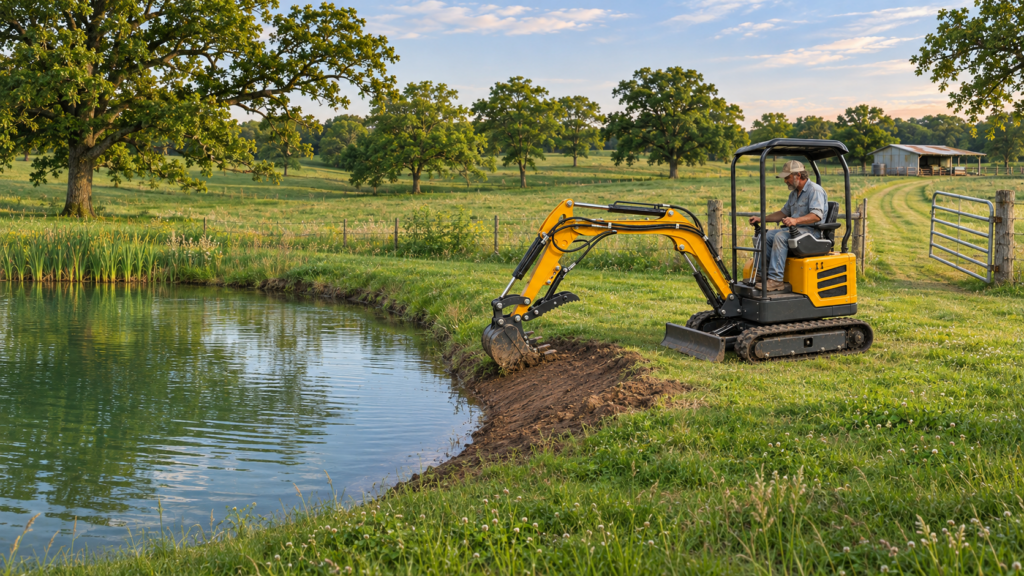
The most common mistake we see is a landowner who buys or rents a machine for the size of the pond they picture, not for the ground they have to cross to get there. The excavator digs fine once it is on site. But it took down a gate post on the way in, sank in the low corner of the pasture, and left ruts that channel runoff for a year after the pond is finished. The water project ends up creating a new water problem.
Mini excavators are one of the best tools a small farm can use for water work. Sized well, they dig precisely, travel lightly and leave very little behind. Here is how to match the machine to the job.
Start with the job, not the machine
Before you look at a single spec sheet, write down the projects you actually have in mind. Most small-farm water work falls into four groups:
- Farm ponds for livestock water, irrigation or wildlife. The biggest digging job on the list, and the one where depth and reach matter most.
- Swales on contour. A swale is a shallow, level ditch dug along the contour of a slope, with the soil piled on the downhill side as a berm. It slows rain running off the hill and lets it soak in instead of carrying topsoil away.
- Drainage ditches and French drains. A French drain is a trench with a perforated pipe in gravel that carries water away from a wet spot, a barn or a building.
- Tree planting, especially rows of trees along swales and pond banks, where an auger on the excavator saves a lot of shovel work.
If most of your list is swales, drains and trees, you need a different machine than if one large pond is the whole reason you are buying.
Dig depth and reach: what each project needs
Dig depth is how far below ground level the bucket can reach. Reach is how far out from the machine it can dig. On water projects, reach often matters as much as depth.
Swales, drains and planting holes rarely need more than 2 to 4 feet of depth, which nearly any mini excavator can handle. Ponds are different. Oklahoma State University’s extension guide says a pond built for fishing should be at least half a surface acre (OSU Extension, Building a Pond), and any pond meant to hold water through a dry summer needs a deeper section somewhere in it.
Reach is what lets you shape a pond bank, cut a gentle slope and spread spoil without repositioning the machine every few minutes. Every time a tracked machine turns and moves, it compacts and scuffs the soil. A machine that can work a wide arc from one spot leaves a smaller footprint.
One caution: the published maximum dig depth is measured straight down. At the far edge of a wide pond, when the arm is reaching out as well as down, the usable depth is less.
Size classes in plain terms
Mini excavators are usually described by their operating weight in tons. As a rough guide, always checked against the manufacturer’s spec sheet for the exact model:
- Compact (1 to 2 tons). Typically digs around 5 to 8 feet deep. Narrow, light and easy to haul. A strong fit for swales, French drains, ditch cleaning, tree planting and small ponds or dugouts. This is the class we sell most of, and the class most small farms can own, haul and store without changing anything else about their setup.
- Mid (3 to 5 tons). Typically reaches roughly 9 to 11 feet and moves noticeably more dirt per bucket. Better suited to larger livestock ponds and long drainage runs.
- Larger (6 to 8 tons). Moves material much faster and handles bigger ponds, but it is heavier on soft ground and much harder to transport.
For a pond much over half an acre, especially an embankment pond with a dam, the work is usually beyond a small machine and beyond a do-it-yourself job. The USDA Natural Resources Conservation Service has a conservation practice standard for ponds (NRCS Pond, Code 378), and your local NRCS office can help with site and soil questions before you dig.
Getting it there and getting it in
A machine is only useful if you can get it to the work.
Gates and openings. Measure the narrowest point between the road and the job: the gate, the gap between two trees, the alley beside the barn. Many 1-ton machines fit through a standard walk-through gate. As machines grow into the 3- to 5-ton range, they often need a full field gate or a fence panel taken down.
Trailer and tow vehicle. Add up the machine’s weight, any attachments riding with it, and the trailer itself, and compare it to your truck’s towing rating from the manufacturer. A compact machine can ride behind many pickups. A mid-size machine on an equipment trailer can push a three-quarter-ton truck to its limit. Under federal rules, a combination rated at 26,001 pounds or more, where the trailer is rated over 10,000 pounds, requires a commercial driver’s license (49 CFR 383.91).
Soft and wet ground. Water projects, by their nature, are in the wettest part of the property. Heavier machines sink and rut. Plan the route in on the driest, firmest path, work when the ground is dry, and lay down mats or planks on soft spots. Ruts left behind become small channels that carry water and soil downhill, which is exactly what you are trying to stop.
Before any digging, call 811 to have buried utilities marked. It is free, and every state requires it (Call 811).
Tracks, attachments and add-ons that help on water work
Rubber tracks spread the machine’s weight and are much easier on pasture and sod than steel tracks or wheels. They are standard on most compact machines.
The bucket digs, but attachments are what make a mini excavator efficient on water projects:
- Hydraulic thumb. Works with the bucket like a thumb and finger to grab rocks, roots, stumps and brush. Handy for clearing a pond site or setting rock where an overflow leaves the pond.
- Tilt bucket. Rotates side to side so you can cut sloped banks and angled swale walls without repositioning the machine.
- Grading bucket. A wide, smooth-edged bucket for shaping berms and pond banks and leaving a clean surface for seeding.
- Auger. Drills planting holes for trees along swales and pond edges, and post holes for fencing livestock away from the bank.
Before buying an attachment, confirm it matches your machine’s pin size and coupler, and that the machine has auxiliary hydraulics with enough flow to run powered tools like an auger.
Caring for the soil while you dig
A water project should leave the land healthier. A few habits make a big difference:
- Strip and save the topsoil. Push it aside before digging, then spread it back over berms and banks so seed has something to grow in.
- Keep passes to a minimum. Plan where the machine will sit and work from as few positions as possible. Reach helps here.
- Seed and cover bare soil right away. Freshly moved dirt erodes with the first hard rain.
- Plan where the dirt goes. On a swale, the spoil becomes the berm. On a pond, it may become the dam, a pad or a fill area. Spoil piled with no plan ends up in the water you just dug.
Common mistakes
- Too small for the pond. A machine that cannot reach the bottom forces the operator to dig from inside the hole, which damages the banks and slows everything down.
- Too big for the gate. The trouble starts before the first scoop.
- No plan for the dirt. A small pond moves a lot of soil. Know where every load is going before you start.
- Skipping the soil question. Not every soil holds water. If you are unsure, ask your local NRCS or extension office before you dig.
Rent, buy or hire it out
A simple way to decide is to count the projects.
- One project, such as a single pond: rent the right size or hire a contractor. A contractor makes the most sense for a large pond with a dam.
- A season of smaller projects, such as swales, drains, a dugout and a few hundred trees: owning a compact machine often pays for itself, and it keeps working afterward on fence lines, ditch cleaning and brush.
- Ongoing work across the farm every year: buy the size that fits most of the work, and rent a bigger machine for the occasional big dig.
Size the machine for the ground you have to cross and the projects you will really do, and a mini excavator becomes one of the most useful tools on the farm for putting water where you want it.

Related Posts

Soil is easy to overlook because most people are taught to think of it as background. It is the surface…