USDA Cuts Winter Wheat Outlook as Plains Drought and Fertilizer Costs Pressure Producers
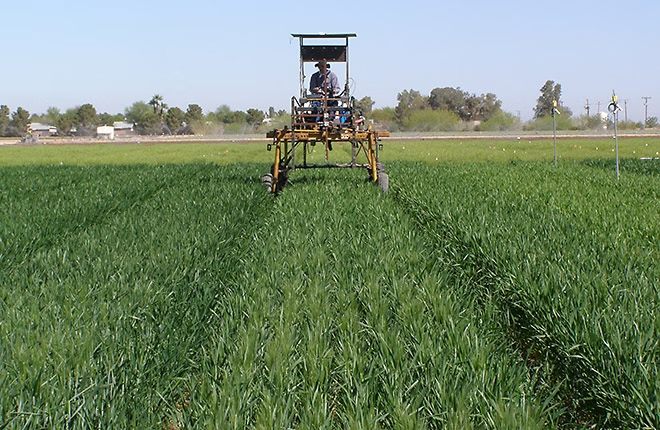
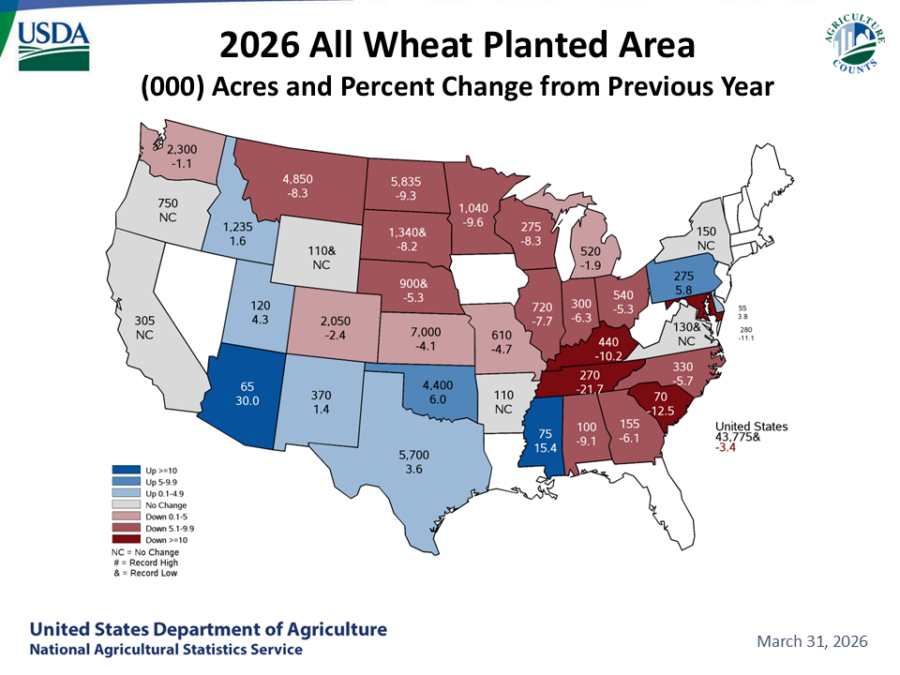
Image: U.S. all wheat planted area by state. Source: USDA National Agricultural Statistics Service.
The U.S. Department of Agriculture lowered its winter wheat production forecast Thursday, adding another financial pressure point for producers in the Plains as harvest begins in major wheat states.
In its June supply-and-demand update, USDA said the U.S. wheat outlook for 2026/27 now projects smaller supplies and lower ending stocks, with all-wheat production forecast at 1.543 billion bushels, down 18 million from May. The agency attributed the decline largely to a smaller hard red winter wheat crop.
USDA stated in the report:
“The U.S. wheat outlook for 2026/27 projects smaller supplies and, with no other changes to the balance sheet, lower ending stocks.”
The update matters most in hard red winter wheat country, where drought has reduced yield potential across parts of Kansas, Oklahoma, and Texas. Reuters reported that USDA cut its U.S. winter wheat production estimate to 1.030 billion bushels, down from 1.048 billion bushels last month and well below last year’s 1.402 billion-bushel crop.
Hard Red Winter Wheat Takes the Largest Hit
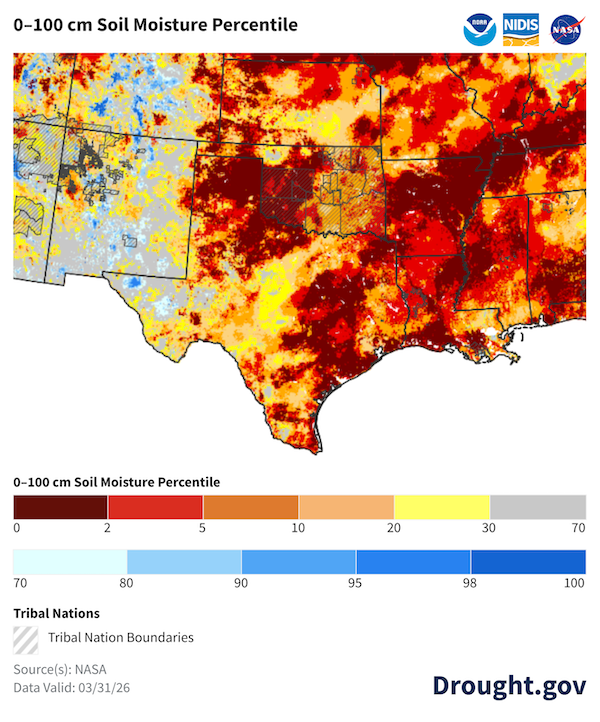
Image: Soil moisture percentiles across Texas, Oklahoma, and Kansas. Source: Drought.gov, NASA, NOAA/NIDIS.
The hard red winter wheat class, used widely in bread flour and grown heavily across the central and southern Plains, is carrying the deepest cut. Reuters reported that USDA projected hard red winter wheat production at 497 million bushels, down from 515 million bushels in May and far below last year’s 804 million bushels.
The June Crop Production report from USDA’s National Agricultural Statistics Service also placed winter wheat production at 1.03 billion bushels, down 2 percent from the May forecast and down 27 percent from 2025. The report gives producers, elevators, millers, and grain buyers a revised baseline as combines move through drought-affected fields.
Crop condition data shows the extent of stress. Reuters reported that USDA rated just 25 percent of the U.S. winter wheat crop in good-to-excellent condition, the lowest rating for this point in the season in USDA records dating to 1986.
Drought Conditions Remain Central to the Farm-Level Impact
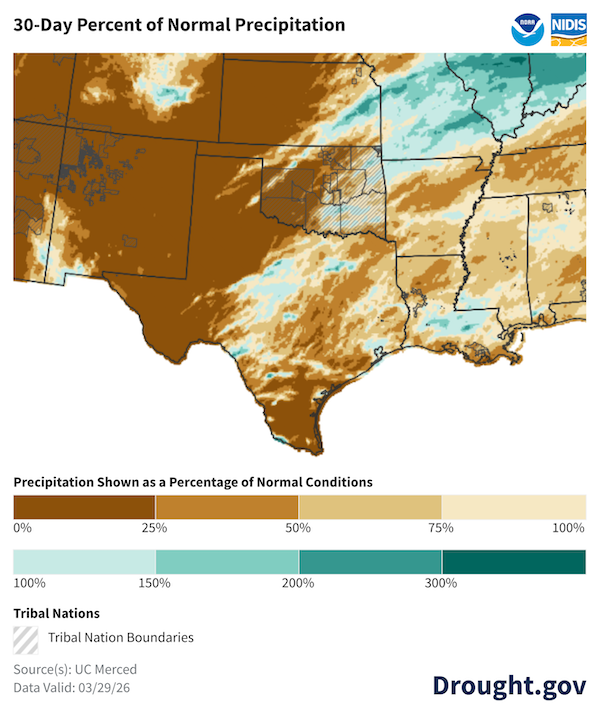
Image: Thirty-day percent of normal precipitation in the Southern Plains. Source: Drought.gov, NOAA/NIDIS, UC Merced.
Drought.gov reported in an April Southern Plains update that Texas and Oklahoma were facing significant drought challenges across multiple regions, affecting rangelands, water supplies, and wildfire risk. The same update said western Kansas was abnormally dry, with moderate to severe drought persisting along the Kansas-Oklahoma border.
The drought update also noted that soil moisture across Texas, Oklahoma, and Kansas was below the 10th percentile for March in many areas, based on NASA SPoRT-LIS data. For wheat producers, that kind of soil profile can reduce tillering, grain fill, and harvestable yield, depending on timing and local rainfall.
Drought.gov summarized the agricultural risk this way:
“Drought can reduce the water availability and water quality necessary for productive farms, ranches, and grazing lands, resulting in significant negative direct and indirect economic impacts to the agricultural sector.”
Input Costs Add Another Layer
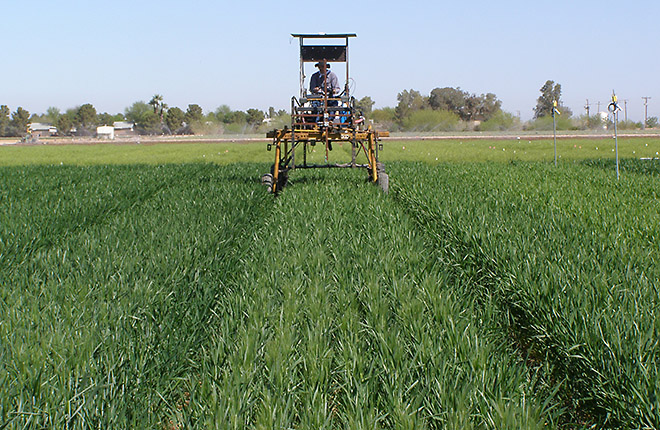
Image: Nitrogen fertilizer applied to a wheat field in Maricopa, Arizona. Source: USDA Agricultural Research Service; photo by M. Conley.
The production cut comes as fertilizer remains a major cost concern for growers. Reuters reported Thursday that President Donald Trump said he was considering assistance for farmers facing high fertilizer prices, though no specific policy details were announced.
According to Reuters, Trump told reporters at the White House:
“We’re thinking about doing something for the farmers, because fertilizer is so expensive.”
The fertilizer issue is broader than wheat, but it is especially relevant for winter wheat producers deciding whether to invest in fertility after difficult stand establishment or limited yield potential. USDA Agricultural Research Service has previously noted that fertilizer management is closely tied to both crop economics and environmental outcomes, reporting that Arizona wheat research found an economic nitrogen rate below the maximum-yield rate when fertilizer costs and market prices were included.
Market Reaction Was Measured
Reuters reported that grain traders largely absorbed the USDA adjustments because the figures fell within analyst expectations. Hard red winter wheat futures were up about 0.6 percent near midday Thursday, while soft red winter wheat futures were slightly lower.
USDA also reduced projected wheat ending stocks to 744 million bushels, down from 762 million bushels in May. The agency lowered the projected season-average farm price for wheat by 50 cents to $6.00 per bushel, according to the June WASDE report.
For farmers, the mixed picture is that smaller production can support prices, but the benefit depends on whether a producer has grain to sell, what was forward-contracted, and how much yield was lost to drought. In the hardest-hit areas, higher futures prices may not fully offset fewer harvested bushels or elevated input costs.
What Producers Are Watching Next
The immediate watch points are harvest results from Kansas, Oklahoma, and Texas, updated crop condition reports, and any federal details on fertilizer-related assistance. Grain buyers and producers will also be watching whether smaller U.S. supplies change export competitiveness as global wheat forecasts shift.
USDA’s June WASDE raised several global wheat figures even as it cut U.S. production. The agency increased Russia’s wheat production forecast by 2 million metric tons to 88 million metric tons, raised Turkey to a record 22.5 million metric tons, and increased Ukraine to 23.5 million metric tons, while lowering Australia by 2 million metric tons to 28 million metric tons.
That global context limits how much a smaller U.S. crop alone can reshape the market. For producers in the Plains, however, the local impact is immediate: drought, yield loss, input costs, and marketing decisions are converging during harvest.
Related Resources

Related Posts
A coalition of 40 major food and agriculture organizations has signed a declaration supporting a new regenerative agriculture framework designed…
The federal government’s new regenerative agriculture funding effort is entering a critical phase for producers, while major private-sector inve...